
Criminal Cases in the Elbert County Courts
Elbert County Superior Court has general jurisdiction and hears felony prosecutions. State Court handles misdemeanors and traffic cases that fall outside a city court. Magistrate Court issues arrest and search warrants and handles preliminary matters. Elberton Municipal Court keeps its own docket for city ordinance and traffic violations. Juvenile Court material is generally restricted. These divisions matter because there is no verified public index that searches every Elbert County criminal case at once.
The Elbert County Clerk of Court records Superior, State, and Juvenile Court proceedings. A county arrest can begin in Magistrate Court and later become a Superior Court case, while a city citation may remain with Elberton Municipal Court. Ask which court owns the file before paying for copies. Case numbers, filing years, and docket formats can differ by court.
Elbert County Courts by Charge
Georgia does not use one universal set of felony classes such as A, B, and C. The statute for the charged offense usually controls the penalty. When no other felony punishment is stated, Georgia law supplies a general range of one to twenty years. Misdemeanors generally carry up to twelve months and a fine, while a high and aggravated misdemeanor keeps the same maximum confinement but permits a higher fine.
The label helps route the search. Felony indictments and related orders belong in Elbert County Superior Court. Misdemeanor accusations usually belong in State Court, unless a law places the matter in Municipal or Magistrate Court. Read the filed statute and charging instrument instead of guessing from a booking-site label.
A traffic or ordinance matter inside Elberton may stay with Municipal Court even when the same name appears in a county search. Keep the citation number and hearing date. They help the city court find its separate docket.
How to Search Case Records
The Georgia court E-Access gateway directs users to participating systems, but it is not a complete statewide criminal index. Elbert State Court access can route through PeachCourt and requires an account. The clerk remains the official custodian, especially for older files, documents not shown online, and certified copies.
- Collect the defendant's full name, name variants, approximate filing year, and exact case number when available.
- Ask the clerk whether the case belongs to Superior or State Court. Route warrants to Magistrate Court and city citations to Municipal Court.
- Register for PeachCourt when the participating-court route fits, then choose Search, Cases, county, and court. Exact case-number format works best.
- Read the docket by count. Locate the charging paper, hearing entries, plea or verdict, disposition, and sentence.
- Request counter, archive, plain, or certified copies from the clerk. Obtain a current fee quote before authorizing retrieval.
| Search Field | Type | Required | Use |
|---|---|---|---|
| Defendant full name | Text | Normally | Include middle name and variants |
| Case number | Text | No | Best unique key; exact court format helps |
| Approximate year | Year | No | Narrows a manual or archive search |
| Date of birth | Date | Unspecified | Ask before sending a sensitive identifier |
| Court | Choice | No | Superior, State, Magistrate, or Municipal |
Elbert Court Records Through PeachCourt
PeachCourt registration is free for attorneys and non-attorneys. Its public sign-up form asks for name, email, password, a secret question and answer, reCAPTCHA, and agreement to its terms. Once signed in, help materials direct a user to Search, then Cases, before selecting the county and court and entering the exact case number. A separate filing lookup uses Search, Filings, and an exact Peach Number.
That account gate does not prove every old Elbert County criminal record, party-name result, or document image is available at no charge. PeachCourt is a route into participating electronic records, not the custodian. Its published help and chat hours are weekdays from 8 a.m. to 5 p.m. Eastern, and the support email is info@peachcourt.com. For a missing result, return to the clerk with the name, year, and court.
The official GSCCCA clerk directory confirms criminal e-filing in Elbert County. It also shows the clerk's office role. This captured directory view illustrates the official county contact route.
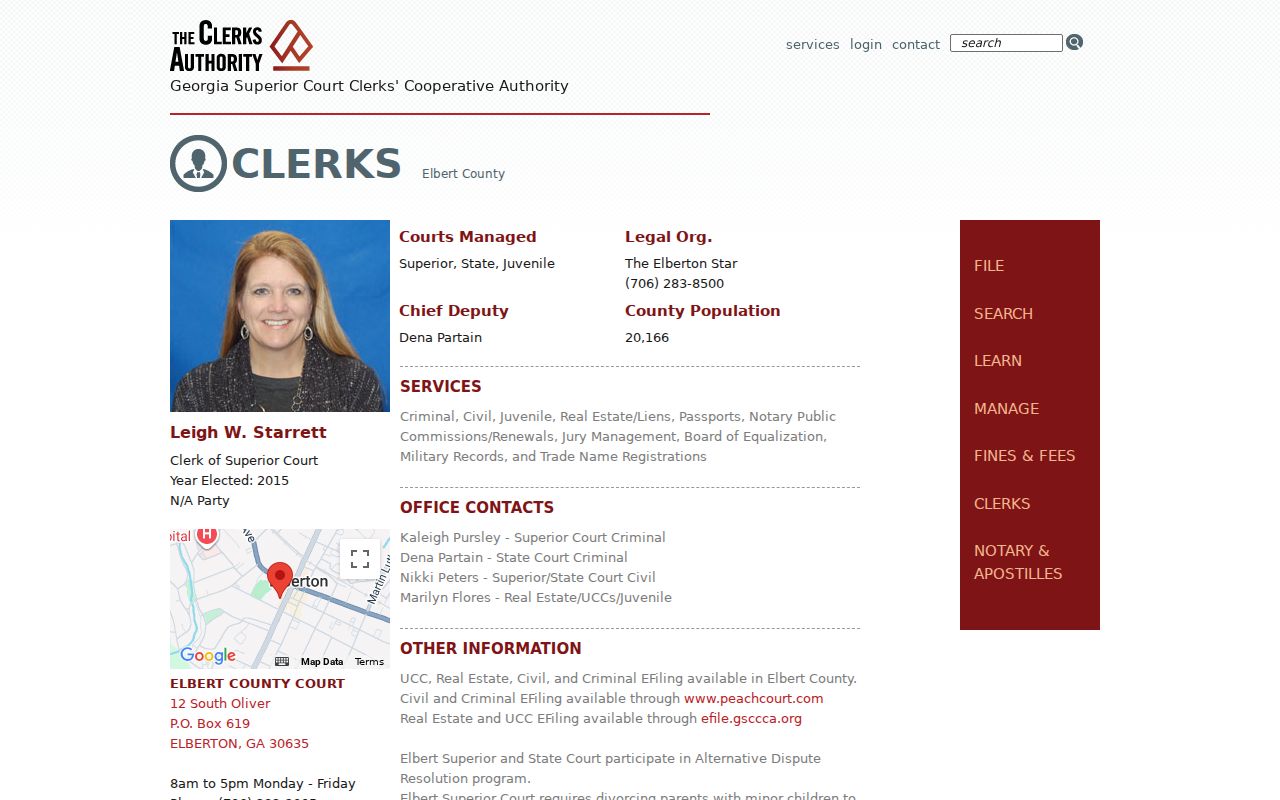
Electronic filing can speed current work, but a clerk search is still the sound fallback for archives and certification.
What the Case File Shows
A court file records litigation rather than just intake. Start with the case number and court. Then compare the accusation or indictment with the disposition for each count. Docket entries provide the sequence, but the signed judgment and sentence are often the clearest proof of outcome. A certified copy bears the clerk's authentication when an official copy is needed.
| Case Number & Court | Unique file key, division, case type, filing date, and open or disposed status. |
|---|---|
| Charging Document | Accusation or indictment with the filed charge, statute, and count. |
| Docket Entries | Filings, motions, arraignment, calendars, hearings, plea, trial, warrants, and appeal activity. |
| Hearing Dates | Scheduled and completed court events; verify current settings with the clerk. |
| Disposition & Judgment | Guilty, dismissal, acquittal, nolle prosequi, dead docket, or no bill when applicable. |
| Sentence & Conditions | Confinement, probation, fines, restitution, costs, and public bond details when docketed. |
Reading Elbert County Case Outcomes
One arrest may produce several counts with different outcomes. Read each row. A dismissal ends that charge in its current form. Nolle prosequi means the prosecutor formally chose not to continue it at that time. A no bill means the grand jury declined to indict. Dead docket postpones prosecution indefinitely and is not the same as a dismissal.
- Arraignment
- The hearing where charges and a plea are addressed.
- Accusation
- A prosecutor's formal charging paper used where Georgia procedure permits.
- Indictment
- A grand jury's true-bill charging document.
- Disposition
- The recorded outcome for a charge.
- First Offender
- A Georgia sentencing treatment that may avoid an adjudication of guilt after successful completion.
Note: A docket status is not a substitute for the signed final disposition or sentencing order.
Stages of a Criminal Case
A case may start with a warrant or arrest, but the court file takes shape when charges are filed. Magistrate Court can handle a warrant and first proceedings. The prosecutor then decides whether to use an accusation or seek an indictment. Superior or State Court records arraignment, motions, hearings, plea negotiations, trial events, and the outcome.
Case flow: Charges Filed › Arraignment › Pretrial › Plea or Trial › Disposition › Sentencing
No fixed local time applies to every stage. Court calendars, motions, evidence, competency issues, and trial needs can change the pace. Use the docket for past events and confirm a future date with the clerk.
A bench warrant on the docket is a court order, not a new finding of guilt. Contact the issuing court to learn the lawful way to address it.
Missing Elbert County Case Outcomes
A GCIC history may show an arrest without the final court result. That gap does not mean the case is still open. GBI advises that missing or incorrect dispositions must be corrected through the court that owns the outcome. First obtain the Elbert County docket and a certified final disposition. Confirm the offense tracking number, arrest date, and count so the correct arrest cycle can be matched.
GCIC cannot change a submitting agency's data without documentation or authorization. If the public court view is also wrong, ask the clerk what source document is needed. Record restriction limits dissemination of qualifying history but does not destroy the record, and sealing the public court file can require a separate order. Keep the certified disposition and any agency confirmation. Recheck both the official history and public court view after the correction is processed, since the two systems may update on different schedules.
Access & Restrictions
Georgia court records are generally accessible through the proper clerk, but public access has limits. Social Security numbers, full birth dates, account data, juvenile details, victim identifiers, and sealed material can be removed or withheld. Online access may show less than the clerk's controlled file. Ask for a segregated or redacted public copy when only part of a document is protected.
The Elbert County Clerk is at 12 South Oliver Street, P.O. Box 619, Elberton, Georgia 30635. The office lists 706-283-2005, fax 706-213-7286, and weekday hours of 8 a.m. to 5 p.m. Copy, search, and certification prices were not found on an official Elbert page, so request a quote. Court entrances use weapons screening. Call ahead about accessibility, device rules, and the file desk.
Elbert County Clerk of Court
12 South Oliver Street
Elberton, GA 30635
706-283-2005
Weekdays, 8 a.m.-5 p.m.
Federal Court Cases from Elbert
Federal crimes do not go into the Elbert County clerk's docket. Elbert County lies in the Middle District of Georgia, Athens Division. PACER is the official federal docket and document system after registration. It charges ten cents per page, usually caps a case-specific document at three dollars, and waives quarterly charges of thirty dollars or less.
The Athens Division is at 115 East Hancock Avenue in Athens. This official court view shows the federal destination for Elbert County matters.
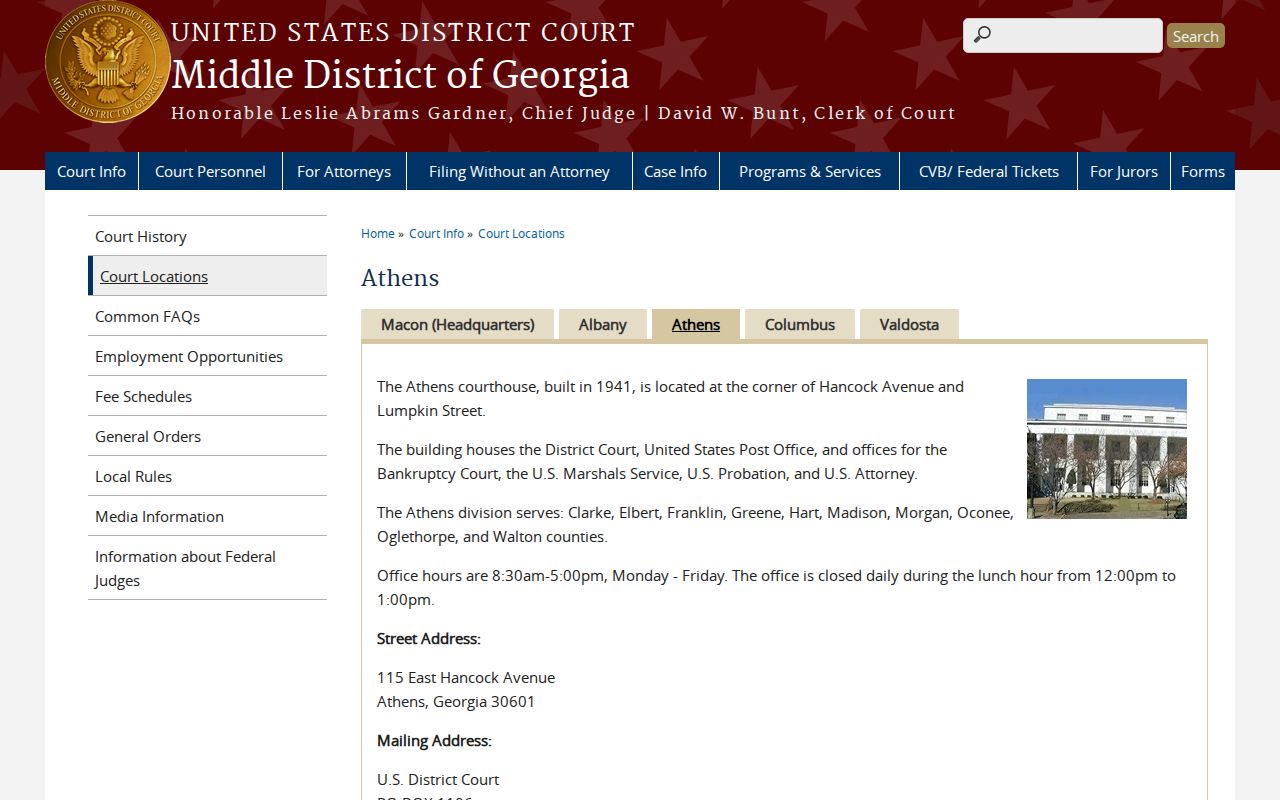
The division clerk can answer federal filing questions, while the county clerk cannot certify a federal docket.
PACER supplies the official federal search. The captured portal view below distinguishes that system from county court access.
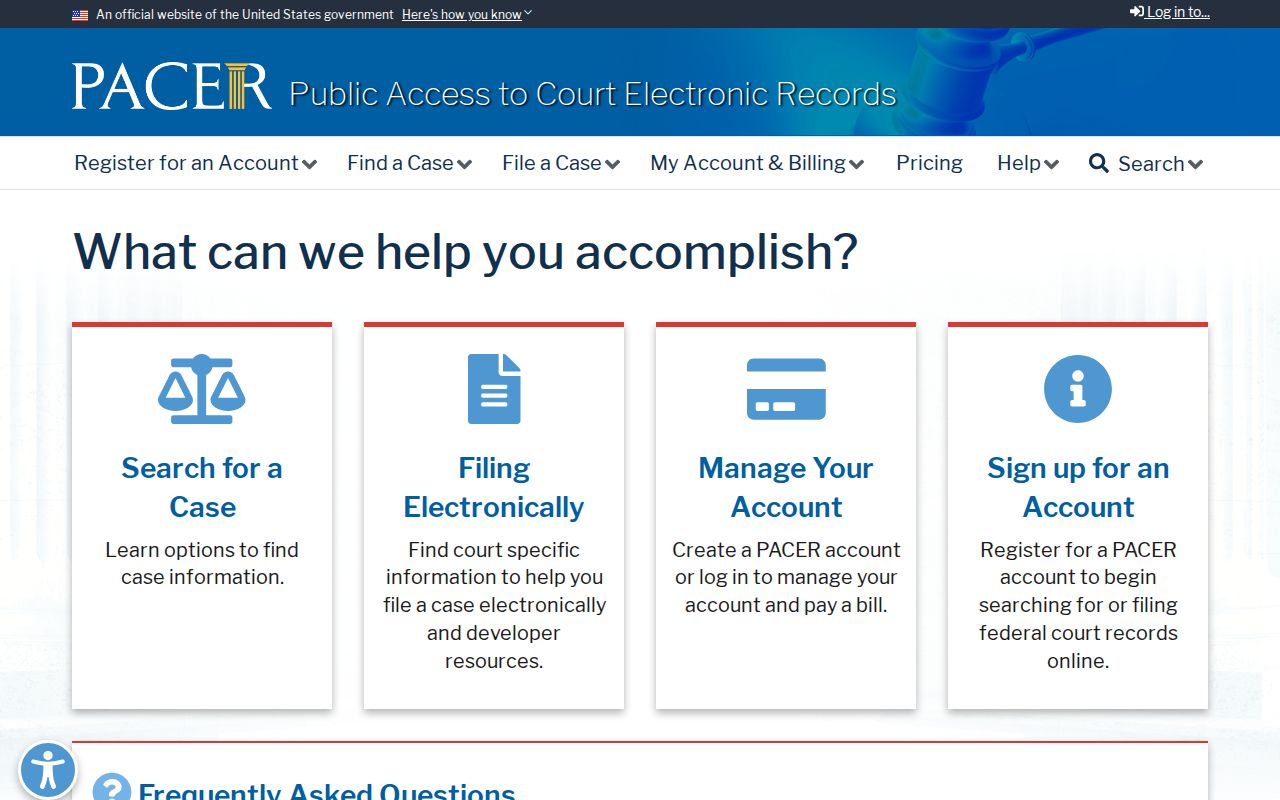
RECAP may hold contributed copies, but it is supplemental and does not replace the official docket.